The Complete Beginner’s Guide to Artificial Intelligence: How AI Works, Types, Applications, and Future Trends
Artificial intelligence has moved from science fiction into everyday life. Whether you unlock your smartphone with facial recognition, receive personalized recommendations on Netflix, use ChatGPT for research, or interact with a customer support chatbot, you are already using artificial intelligence.
In 2026, AI is transforming industries, changing how businesses operate, and creating new opportunities for professionals worldwide. Yet many people still find AI confusing because of technical terms such as machine learning, deep learning, neural networks, and large language models.
This beginner-friendly guide explains artificial intelligence in simple language. You’ll learn what AI is, how it works, the different types of AI, real-world applications, benefits, limitations, and what the future may hold.
Why Artificial Intelligence Is Transforming Every Industry
Artificial intelligence is no longer limited to research laboratories. Businesses across healthcare, finance, retail, manufacturing, education, and technology rely on AI to improve efficiency and decision-making.
The rapid growth of computing power, cloud infrastructure, and access to massive amounts of data has accelerated AI adoption. Organizations can now process information faster than ever before and uncover insights that would take humans days or weeks to discover.
AI is helping companies:
- Automate repetitive tasks
- Improve customer experiences
- Reduce operational costs
- Detect fraud and security threats
- Predict future trends
- Create personalized recommendations
As AI tools become more accessible, even small businesses can benefit from technology that was once available only to large enterprises.
What Artificial Intelligence Actually Means
Artificial intelligence refers to computer systems that can perform tasks that normally require human intelligence.
These tasks include:
- Learning from data
- Recognizing patterns
- Understanding language
- Solving problems
- Making decisions
- Generating content
Unlike traditional software that follows fixed rules, AI systems can learn from experience and improve over time.
For example, a traditional calculator follows specific instructions. An AI-powered system can analyze thousands of examples, identify patterns, and make predictions without being explicitly programmed for every scenario.
The goal of artificial intelligence is not necessarily to replace humans but to augment human capabilities and help solve complex problems more efficiently.
The Building Blocks of AI
Understanding the core components of artificial intelligence makes the technology much easier to grasp.
Machine Learning
Machine learning is a subset of artificial intelligence that enables computers to learn from data without explicit programming.
Instead of following fixed instructions, machine learning algorithms identify patterns in large datasets and use those patterns to make predictions or decisions.
Examples include:
- Email spam detection
- Product recommendations
- Credit risk analysis
- Fraud detection
Machine learning powers many of the AI systems people interact with daily.
Deep Learning
Deep learning is a specialized branch of machine learning that uses artificial neural networks with multiple layers.
These systems can process enormous amounts of information and are especially effective at:
- Image recognition
- Speech recognition
- Language translation
- Content generation
Deep learning is responsible for many recent breakthroughs in artificial intelligence.
Neural Networks
Neural networks are computing systems inspired by the structure of the human brain.
They consist of interconnected nodes that process information and learn relationships within data.
When trained on large datasets, neural networks can recognize faces, understand speech, and generate realistic text, images, and videos.
Large Language Models
Large Language Models, often called LLMs, are advanced AI systems trained on massive collections of text.
These models can:
- Answer questions
- Generate content
- Summarize information
- Translate languages
- Assist with coding
Popular examples include ChatGPT, Claude, and Gemini. Our dedicated guide on how generative AI actually works breaks down the mechanics behind these tools in detail.
LLMs have significantly expanded the capabilities of generative AI and transformed how people interact with technology.
Types of AI Explained
Artificial intelligence is generally categorized into three main types.
Narrow AI
Narrow AI is designed to perform specific tasks.
Examples include:
- Voice assistants
- Recommendation engines
- Search algorithms
- Customer service chatbots
Most AI systems used today fall into this category.
General AI
Artificial General Intelligence refers to a theoretical AI system capable of performing any intellectual task that a human can perform.
Researchers continue to work toward this goal, but true AGI does not yet exist.
Super AI
Super AI is a hypothetical future form of artificial intelligence that surpasses human intelligence across all domains.
While widely discussed in science fiction, Super AI remains speculative and has not been achieved.
How AI Systems Learn
Artificial intelligence systems learn through training.
The process typically involves:
Data Collection
AI models require large amounts of data to learn patterns and relationships.
Training
Algorithms analyze data and adjust internal parameters to improve performance.
Testing
The model is evaluated using new data to measure accuracy.
Deployment
Once trained, the AI system is used in real-world applications.
Continuous Improvement
Many AI systems continue learning and improving as they process new information.
The quality of the data often determines the effectiveness of the AI system.
Generative AI and Modern AI Tools
Generative AI has become one of the fastest-growing areas of artificial intelligence.
Unlike traditional AI systems that analyze information, generative AI creates new content.
This includes:
- Articles
- Images
- Videos
- Code
- Music
- Designs
Businesses use generative AI for:
- Content creation
- Customer support
- Marketing campaigns
- Software development
- Research assistance
The popularity of AI assistants has introduced millions of people to artificial intelligence for the first time.
As these tools continue evolving, they are becoming more capable and accessible.
Artificial Intelligence in Everyday Life
Many people use artificial intelligence daily without realizing it.
Examples include:
Smartphones
Facial recognition, predictive text, and voice assistants all rely on AI.
Streaming Services
Recommendation algorithms suggest movies, shows, and music based on user preferences.
Online Shopping
Retail platforms use AI to personalize product recommendations.
Navigation Apps
AI helps optimize routes and predict traffic conditions.
Social Media
Content feeds are often powered by machine learning algorithms that analyze user behavior.
These applications demonstrate how deeply artificial intelligence has become integrated into modern life.
Artificial Intelligence in Business
Businesses are rapidly adopting AI to gain competitive advantages.
Common business applications include:
Customer Support
AI chatbots provide instant assistance and reduce response times.
Marketing
Companies use AI to analyze customer behavior and improve campaign performance.
Sales
Predictive analytics help identify high-value opportunities.
Operations
AI automates repetitive tasks and improves efficiency.
Decision-Making
Advanced analytics support strategic planning and forecasting.
Organizations that effectively integrate AI often achieve higher productivity and better customer experiences.
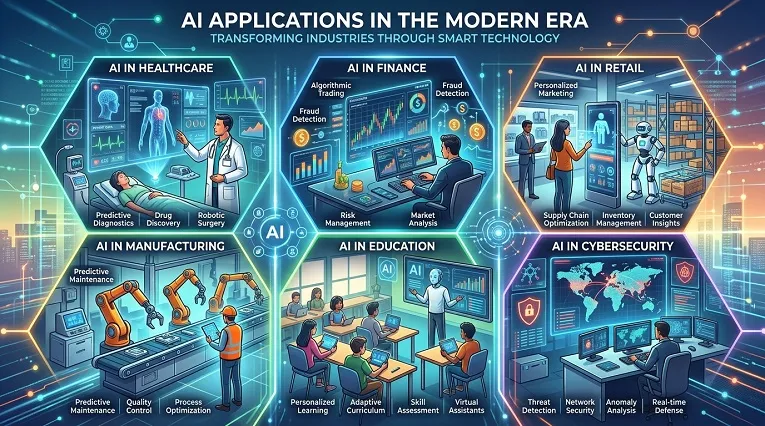
Industries Being Changed by AI
Healthcare
AI assists with medical imaging, disease diagnosis, drug discovery, and patient monitoring.
Finance
Financial institutions use AI for fraud detection, risk assessment, and automated trading.
Retail
Retailers leverage AI for inventory management, demand forecasting, and personalization.
Manufacturing
Predictive maintenance and automation improve production efficiency.
Education
AI-powered learning platforms create personalized educational experiences.
Cybersecurity
Security systems use machine learning to detect threats and identify unusual activity.
The influence of AI continues to expand across nearly every industry.
Benefits of AI
Artificial intelligence offers numerous advantages.
Increased Efficiency
Automation reduces time spent on repetitive tasks.
Better Decision-Making
AI can analyze large datasets quickly and identify patterns humans may overlook.
Cost Reduction
Businesses can streamline operations and reduce manual workloads.
Improved Accuracy
AI systems often perform certain tasks with high precision.
Personalization
Companies can deliver tailored experiences to customers.
Scalability
AI solutions can handle large volumes of work without proportional increases in staffing.
These benefits explain why AI adoption continues accelerating worldwide.
Limitations of AI
Despite its capabilities, artificial intelligence has important limitations.
Data Dependency
AI requires high-quality data to perform effectively.
Bias
Biased training data can lead to unfair outcomes.
Lack of Human Judgment
AI cannot fully replicate human creativity, empathy, or ethical reasoning.
High Implementation Costs
Developing and maintaining AI systems can require significant investment.
Security Risks
AI systems may become targets for cyberattacks or manipulation.
Understanding these limitations helps organizations implement AI responsibly.
AI Security Risks
As AI adoption grows, cybersecurity concerns become increasingly important.
Potential risks include:
- Data breaches
- Model manipulation
- Deepfake content (our guide to spotting deepfakes covers this specifically)
- Automated phishing attacks
- Adversarial attacks
Organizations must combine AI innovation with strong security practices to minimize threats.
Responsible governance and continuous monitoring are essential components of AI security.
Ethics and Regulation
AI ethics focuses on ensuring that artificial intelligence is developed and used responsibly.
Key considerations include:
Transparency
Users should understand how AI systems make decisions.
Fairness
AI should avoid discrimination and bias.
Privacy
Organizations must protect sensitive personal information.
Accountability
Companies should remain responsible for AI-driven decisions.
Governments and regulatory bodies worldwide are actively developing frameworks to guide AI development and deployment.
Will AI Replace Human Jobs?
One of the most common concerns about artificial intelligence is job displacement.
While AI will automate certain tasks, history suggests technology often creates new opportunities alongside disruption.
AI is likely to:
- Eliminate repetitive work
- Increase productivity
- Create new technology-focused roles
- Change skill requirements
Professionals who learn to work alongside AI may benefit significantly from the evolving job market.
The future will likely involve collaboration between humans and intelligent systems rather than complete replacement.
Future AI Trends for 2026 and Beyond
Several trends are expected to shape the future of artificial intelligence.
More Powerful Generative AI
Content creation tools will become increasingly sophisticated.
AI Agents
Autonomous systems capable of completing complex tasks will become more common. Our dedicated guide on AI agents covers how these systems already work today.
Industry-Specific AI
Specialized solutions will emerge for healthcare, finance, legal services, and education.
Improved Human-AI Collaboration
AI will function more as an assistant rather than a replacement.
Stronger Regulation
Governments will continue introducing frameworks to address safety, transparency, and accountability.
Artificial intelligence will remain one of the most influential technologies of the coming decade.
How to Learn AI as a Beginner
Learning AI has never been more accessible.
A practical roadmap includes:
- Understand AI fundamentals.
- Learn basic data concepts.
- Explore machine learning principles.
- Practice using AI tools.
- Study real-world applications.
- Follow industry developments.
- Build small projects.
Consistency is more important than speed. Even non-technical professionals can develop a strong understanding of AI concepts.
Best Resources and Tools for Learning AI
Beginners can accelerate learning through:
- Online courses
- AI newsletters
- Technology blogs
- Research publications
- AI communities
- Hands-on experimentation
Using AI tools regularly helps reinforce concepts and develop practical skills.
Key Takeaways
Artificial intelligence is transforming how individuals and organizations operate. Understanding the fundamentals of AI, machine learning, deep learning, and generative AI provides a strong foundation for navigating the future. While challenges such as bias, privacy concerns, and security risks remain important considerations, the opportunities created by AI continue to expand across industries.
Whether you are a student, business owner, or technology enthusiast, learning about artificial intelligence today can help you prepare for tomorrow’s digital economy.
FAQ
What is artificial intelligence in simple terms?
Artificial intelligence is technology that enables computers and machines to perform tasks that usually require human intelligence, such as learning, problem-solving, language understanding, and decision-making.
What is the difference between AI and machine learning?
AI is the broader field focused on creating intelligent systems. Machine learning is a subset of AI that allows computers to learn from data without being explicitly programmed for every task.
How is artificial intelligence used in everyday life?
AI powers voice assistants, recommendation systems, navigation apps, online shopping suggestions, spam filters, facial recognition, and customer support chatbots.
Can artificial intelligence replace human jobs?
AI may automate repetitive tasks, but it is also creating new job opportunities in technology, data science, AI development, cybersecurity, and business operations. Most industries will experience collaboration between humans and AI rather than complete replacement.
How can beginners start learning artificial intelligence?
Beginners should start with AI fundamentals, understand machine learning concepts, explore AI tools, complete online courses, and practice using real-world AI applications.
About the Author