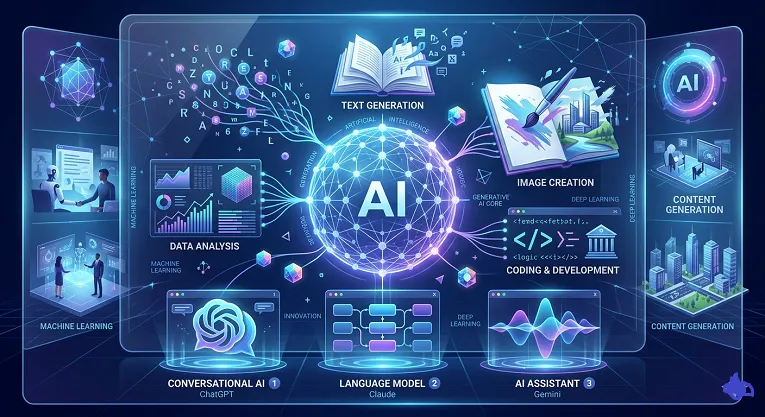
Generative AI Explained: How ChatGPT, Claude, and Gemini Actually Work
Generative AI has quickly become one of the most transformative technologies of the modern era. From writing articles and generating images to creating software code and analyzing complex data, generative AI is changing how people work, learn, and communicate.
Tools such as ChatGPT, Claude, and Gemini have introduced millions of users to artificial intelligence, making advanced AI capabilities accessible through simple conversations. Businesses are using generative AI to improve productivity, automate repetitive tasks, enhance customer service, and accelerate innovation. At the same time, students, researchers, marketers, and developers are discovering new ways to leverage AI in their daily work.
Despite its growing popularity, many people still wonder: What is generative AI, and how does it actually work?
This guide explains the technology behind generative AI in simple language. You’ll learn how AI models are trained, how they generate content, what large language models are, and why systems like ChatGPT, Claude, and Gemini often produce different responses to the same question. By the end, you’ll have a clear understanding of one of the most important technological breakthroughs of the 21st century.
Why Generative AI Is Transforming Technology
The Rapid Growth of AI Adoption
Artificial intelligence has existed for decades, but recent advances in computing power, machine learning, and data availability have accelerated its development dramatically. Generative AI represents a significant leap forward because it doesn’t simply analyze information. It creates entirely new content based on patterns learned from massive datasets.
Unlike traditional software that follows predefined rules, generative AI can generate human-like text, realistic images, software code, audio, and even video. This capability has opened opportunities across nearly every industry.
Organizations are integrating AI into customer support systems, marketing campaigns, software development processes, and business intelligence workflows. Small businesses are using AI to compete with larger enterprises by automating tasks that previously required dedicated teams.
The accessibility of modern AI tools has also played a major role in adoption. Previously, advanced AI required specialized knowledge and technical expertise. Today, anyone can interact with AI through simple natural language prompts.
Why Businesses Are Investing in Generative AI
Businesses see generative AI as a way to increase efficiency while reducing operational costs. Many repetitive tasks that once required hours of manual work can now be completed in minutes.
Examples include:
- Drafting emails
- Creating marketing content
- Summarizing reports
- Conducting research
- Generating software code
- Analyzing customer feedback
Organizations that effectively implement AI often experience improvements in productivity and faster decision-making. Instead of replacing employees, successful companies use AI to augment human capabilities and allow teams to focus on higher-value activities.
The Impact on Productivity and Innovation
Generative AI is not merely an automation tool. It acts as a productivity multiplier.
A marketing professional can generate campaign ideas faster. A developer can write code more efficiently. A researcher can analyze large volumes of information in less time.
This ability to accelerate knowledge work is one of the primary reasons generative AI is considered a transformational technology. Similar to how the internet changed access to information, generative AI is changing how information is created and utilized.
What Is Generative AI?
Generative AI Definition
Generative AI refers to artificial intelligence systems that can create new content based on patterns learned from existing data.
Rather than simply recognizing patterns or making predictions, generative AI generates outputs such as:
- Text
- Images
- Audio
- Video
- Software code
- Designs
The word “generative” comes from the model’s ability to generate original content that did not previously exist.
For example, when you ask ChatGPT to write an article about cybersecurity, it doesn’t retrieve a pre-written article from a database. Instead, it generates new content by predicting which words are most likely to appear next based on what it learned during training.
Generative AI vs Traditional AI
Traditional AI systems are often designed to perform specific tasks.
Examples include:
- Spam detection
- Fraud detection
- Product recommendations
- Image classification
These systems focus on identifying patterns and making predictions.
Generative AI goes a step further by creating new outputs.
| Traditional AI | Generative AI |
| Detects spam | Writes emails |
| Recognizes images | Creates images |
| Predicts outcomes | Generates content |
| Classifies data | Produces new data |
This distinction is one of the reasons generative AI has attracted significant attention.
Real-World Examples of Generative AI
Generative AI is already part of everyday life.
Examples include:
Text Generation
- ChatGPT
- Claude
- Gemini
Image Generation
- DALL·E
- Midjourney
- Stable Diffusion
Code Generation
- GitHub Copilot
- Amazon CodeWhisperer
Video Generation
- Runway
- Sora
Audio Generation
- AI voice assistants
- Speech synthesis tools
These applications demonstrate the versatility of generative AI across multiple domains.
How Generative AI Actually Works
One of the biggest misconceptions about generative AI is that it “understands” information the way humans do.
In reality, generative AI operates through sophisticated mathematical models that identify patterns in massive datasets.
Let’s break down the process.
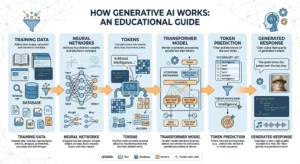
Training Data Explained
Every generative AI model begins with training data.
Training data may include:
- Books
- Articles
- Websites
- Research papers
- Images
- Audio recordings
- Code repositories
During training, the AI analyzes billions of examples and learns relationships between words, concepts, and patterns.
For example, it may learn that:
- “Coffee” is commonly associated with “cup”
- “Programming” often appears alongside “software”
- “London” is associated with the United Kingdom
The model does not memorize every document. Instead, it learns statistical patterns from vast amounts of information.
How AI Learns Patterns
Machine learning models identify relationships within data.
If a sentence repeatedly appears as:
Artificial intelligence is transforming _____
the model learns that words like:
- technology
- business
- industries
are likely candidates.
By analyzing billions of similar patterns, the AI becomes increasingly effective at predicting future content.
This process forms the foundation of generative AI.
Neural Networks Simplified
At the core of modern AI systems are neural networks.
The structure of the human brain inspires a neural network, although it functions very differently.
Neural networks consist of interconnected mathematical nodes that process information and adjust themselves based on training data.
As training progresses, the network becomes better at identifying patterns and generating useful outputs.
Modern AI models contain billions or even trillions of parameters that help determine how information is processed.
What Are Tokens?
One of the most important concepts in generative AI is the token.
A token is a small unit of text.
For example:
Sentence:
Generative AI is powerful.
May be divided into tokens such as:
- Generative
- AI
- is
- powerful
- .
AI models do not process entire paragraphs at once. Instead, they analyze sequences of tokens.
Understanding tokens is essential because AI generates content one token at a time.
How Token Prediction Generates Responses
This is where the magic happens.
When you enter a prompt, the AI does not search for a prepared answer.
Instead, it predicts the most likely next token.
Example:
Prompt:
The capital of France is
The model calculates probabilities and determines that:
Paris
is the most likely next token.
It then predicts the next token after that.
And the next.
And the next.
This rapid sequence of predictions creates the appearance of a coherent conversation.
Every article, email, explanation, or piece of code generated by AI is essentially a sophisticated chain of token predictions.
The Transformer Breakthrough
Generative AI would not exist in its current form without a major innovation called the Transformer.
Before Transformers, AI systems struggled to understand long sequences of information.
Researchers introduced the Transformer architecture to improve how models process context and relationships between words.
This breakthrough became the foundation for modern systems such as ChatGPT, Claude, and Gemini.
What Is a Transformer Model?
A Transformer is a neural network architecture specifically designed to handle sequential data efficiently.
Rather than reading information one word at a time, Transformers can evaluate relationships across entire sequences simultaneously.
This allows them to understand context far more effectively than previous AI approaches.
Attention Mechanisms Explained
A key feature of Transformers is the attention mechanism.
Attention helps the model determine which parts of a sentence are most important.
Consider the sentence:
The dog chased the ball because it was moving.
The model uses attention to understand that “it” refers to “the ball” rather than “the dog.”
This ability to identify relationships improves comprehension and response quality.
Why Transformers Revolutionized AI
Transformers enabled:
- Larger models
- Better context understanding
- Improved language generation
- Faster training
Nearly every modern generative AI system relies on Transformer-based architectures.
Without this innovation, tools like ChatGPT, Claude, and Gemini would not exist.
What Are Large Language Models (LLMs)?
Large Language Models, often called LLMs, are the foundation of most modern text-based generative AI systems.
An LLM is a machine learning model trained on enormous volumes of text data to predict and generate language.
Examples include:
- GPT models
- Claude models
- Gemini models
Understanding Foundation Models
Foundation models are large AI systems trained on broad datasets before being adapted for specific tasks.
These models provide a flexible base that can support:
- Writing
- Coding
- Translation
- Summarization
- Research assistance
Foundation models are the backbone of today’s most powerful AI tools.
How LLMs Are Trained
Training an LLM involves:
- Collecting massive datasets.
- Processing data into tokens.
- Training neural networks.
- Optimizing predictions.
- Fine-tuning outputs.
This process requires significant computing resources and often takes months to complete.
Fine-Tuning and Specialization
After general training, developers often fine-tune models for specific objectives.
Examples include:
- Customer service
- Legal analysis
- Medical research
- Software development
Fine-tuning improves performance for specialized tasks.
Context Windows Explained
One concept competitors often overlook is the context window.
A context window refers to the amount of information an AI model can consider at one time.
Larger context windows allow models to:
- Analyze longer documents
- Maintain conversation history
- Process complex projects
This capability plays a major role in determining how effectively AI systems handle large amounts of information.
How ChatGPT Works
Among all generative AI tools, ChatGPT is arguably the most recognized. Developed by OpenAI, ChatGPT introduced millions of people to conversational AI and demonstrated how powerful large language models can be in everyday tasks.
While it feels like you’re chatting with an intelligent assistant, ChatGPT is fundamentally a sophisticated prediction engine built on GPT (Generative Pre-trained Transformer) models.
The Technology Behind ChatGPT
ChatGPT is trained using enormous amounts of text from books, websites, articles, documentation, and other publicly available information sources.
The training process occurs in multiple stages:
Pre-Training
During pre-training, the model learns language patterns by predicting missing words and tokens across billions of examples.
For instance, if the sentence is:
“The Earth revolves around the ____”
the model learns that “Sun” is the statistically most likely completion.
Repeating this process billions of times enables the model to learn grammar, facts, reasoning patterns, and contextual relationships.
Fine-Tuning
After pre-training, the model undergoes additional refinement.
Human reviewers evaluate responses and help improve the quality, safety, and usefulness of generated outputs.
This process helps align responses with human expectations.
Inference
When users submit prompts, the model generates responses token by token using learned probability distributions.
No database lookup occurs.
The model creates each response in real time.
Strengths of ChatGPT
ChatGPT excels in several areas:
Content Creation
It can generate:
- Blog posts
- Emails
- Marketing copy
- Social media content
- Product descriptions
Coding Assistance
Developers use ChatGPT to:
- Generate code
- Debug errors
- Explain programming concepts
- Create documentation
Research Support
Users can summarize information, brainstorm ideas, and simplify complex topics.
General Versatility
One of ChatGPT’s greatest strengths is its adaptability across different use cases.
Weaknesses of ChatGPT
Despite its capabilities, ChatGPT has limitations.
Hallucinations
It may generate inaccurate information that sounds convincing.
Knowledge Limitations
Its responses depend on training and available data.
Prompt Sensitivity
The quality of responses often depends heavily on prompt quality.
Best Use Cases
ChatGPT is particularly useful for:
- Writers
- Marketers
- Students
- Researchers
- Entrepreneurs
- Developers
Its broad capabilities make it one of the most versatile generative AI tools available.
How Claude Works
Developed by Anthropic, Claude is another leading generative AI assistant.
Claude was designed with a strong focus on safety, reasoning, and helpfulness.
Many professionals prefer Claude for long-form writing and document analysis because of its ability to maintain context across lengthy conversations.
Anthropic’s Approach to AI
Anthropic developed Claude using an approach known as Constitutional AI.
Instead of relying solely on human feedback, Claude is trained to follow a set of principles intended to encourage safer and more reliable behavior.
The goal is to create AI systems that provide useful assistance while reducing harmful or misleading outputs.
Strengths of Claude
Long Context Handling
Claude is known for processing large documents effectively.
This makes it valuable for:
- Research papers
- Contracts
- Reports
- Technical documentation
Natural Writing Style
Many users find Claude’s writing more conversational and nuanced.
Strong Analytical Skills
Claude performs particularly well when evaluating complex information and producing structured analyses.
Weaknesses of Claude
Fewer Ecosystem Integrations
Compared to some competitors, Claude has a smaller ecosystem of third-party integrations.
Conservative Responses
Its emphasis on safety may sometimes result in more cautious answers.
Best Use Cases
Claude is particularly effective for:
- Researchers
- Consultants
- Analysts
- Technical writers
- Legal professionals
- Business strategists
How Gemini Works
Gemini is Google’s flagship generative AI model and represents the company’s long-term vision for AI-powered productivity and information retrieval.
Developed by Google, Gemini is deeply integrated into Google’s ecosystem.
Google’s Multimodal Vision
One of Gemini’s defining characteristics is its multimodal design.
Traditional AI systems often focus primarily on text.
Gemini is designed to work across multiple forms of information simultaneously, including:
- Text
- Images
- Audio
- Video
- Documents
This multimodal capability enables more flexible interactions.
For example, users can upload images, analyze charts, review documents, and ask questions within a single workflow.
Strengths of Gemini
Integration With Google Services
Gemini works closely with:
- Google Search
- Google Workspace
- Google Docs
- Google Sheets
- Gmail
This integration creates productivity advantages for existing Google users.
Strong Information Access
Google’s expertise in information retrieval helps Gemini perform effectively in research-oriented tasks.
Multimodal Capabilities
Gemini’s ability to process multiple content formats is one of its major strengths.
Weaknesses of Gemini
Variable Response Quality
Performance may vary depending on task complexity.
Ecosystem Dependency
Its greatest benefits often appear when users already rely on Google’s products.
Best Use Cases
Gemini works well for:
- Researchers
- Students
- Business professionals
- Teams using Google Workspace
- Data analysis workflows
ChatGPT vs Claude vs Gemini
One of the most common questions users ask is:
Which AI model is best?
The answer depends on the specific use case.
Writing Quality
ChatGPT
Excellent balance between creativity and structure.
Claude
Often produces highly natural and polished long-form writing.
Gemini
Strong but sometimes less consistent for extended content generation.
Winner
Claude for long-form writing.
Research and Information Retrieval
ChatGPT
Strong explanations and synthesis.
Claude
Excellent analysis and interpretation.
Gemini
Benefits from Google’s information ecosystem.
Winner
Gemini for research-heavy workflows.
Reasoning and Analysis
ChatGPT
Strong reasoning performance across many domains.
Claude
Particularly effective with complex documents and detailed analysis.
Gemini
Improving rapidly in reasoning tasks.
Winner
ChatGPT and Claude are closely matched.
Coding Capabilities
ChatGPT
Excellent for development tasks.
Claude
Strong coding assistance and debugging.
Gemini
Capable but less commonly preferred by developers.
Winner
ChatGPT.
Multimodal Features
ChatGPT
Supports multiple content formats.
Claude
Expanding multimodal capabilities.
Gemini
Built with multimodal functionality as a core design principle.
Winner
Gemini.
Which Model Should You Choose?
Choose ChatGPT If You Need:
- Versatility
- Coding assistance
- Content creation
- General productivity
Select Claude If You Need:
- Long-form writing
- Document analysis
- Research
- Strategic planning
Choose Gemini If You Need:
- Google integration
- Research workflows
- Multimodal tasks
Many professionals actually use multiple AI models depending on the task.
Why Generative AI Sometimes Gets Things Wrong
One of the most misunderstood aspects of generative AI is accuracy.
Many users assume AI systems always provide correct information.
In reality, generative AI models generate responses based on probabilities rather than true understanding.
This creates several challenges.
AI Hallucinations Explained
A hallucination occurs when an AI system generates information that is false, misleading, or entirely fabricated.
For example, an AI may:
- Invent statistics
- Create non-existent sources
- Misquote information
- Generate inaccurate facts
The response may appear convincing even when incorrect.
This happens because the model predicts likely language patterns rather than verifying facts.
Bias in Training Data
AI systems learn from human-generated information.
If biases exist within training data, those biases can influence outputs.
Potential issues include:
- Cultural bias
- Historical bias
- Representation gaps
Developers continuously work to reduce these effects.
Knowledge Limitations
AI models do not possess real-world awareness.
They operate using information learned during training and any available retrieval systems.
As a result:
- Some information may be outdated.
- Certain niche topics may be poorly represented.
- Emerging events may not be fully understood.
Prompt Quality and User Influence
The quality of outputs depends significantly on prompts.
Poor prompts often produce vague or inaccurate responses.
Effective prompts provide:
- Clear objectives
- Relevant context
- Specific requirements
Prompt engineering has become an important skill because better prompts typically produce better results. Our full beginner’s guide to prompt engineering covers this in much more depth.
Types of Generative AI
Generative AI is not limited to text generation. Modern AI systems can create various forms of content, enabling businesses and individuals to automate creative and technical tasks that once required significant human effort.
Understanding the different types of generative AI helps illustrate how rapidly the technology is evolving.
Text Generation
Text generation is the most widely recognized application of generative AI.
Tools such as ChatGPT, Claude, and Gemini can generate:
- Articles
- Emails
- Reports
- Product descriptions
- Social media posts
- Research summaries
Organizations use text generation to scale content production while reducing time spent on repetitive writing tasks.
For example, marketing teams can create first drafts of blog posts, while customer support teams can generate responses to common inquiries.
Image Generation
Image generation models create visual content based on text prompts.
Popular examples include:
- DALL·E
- Midjourney
- Stable Diffusion
These systems can produce:
- Marketing graphics
- Product mockups
- Concept art
- Illustrations
- Social media visuals
Businesses are increasingly using AI-generated images to accelerate design workflows and reduce production costs.
Video Generation
Video generation represents one of the fastest-growing areas of AI development.
Modern systems can create:
- Short promotional videos
- Animated content
- Product demonstrations
- Educational materials
As video generation technology improves, organizations may significantly reduce the time and resources required to produce high-quality visual content.
Audio Generation
Generative AI can also create audio content.
Examples include:
- AI voiceovers
- Podcasts
- Speech synthesis
- Music generation
These capabilities are transforming industries such as entertainment, education, and customer service.
Code Generation
Code generation tools help developers write software more efficiently.
AI-powered coding assistants can:
- Generate code snippets
- Explain programming concepts
- Identify bugs
- Suggest improvements
- Create documentation
This application of generative AI has become particularly valuable for software development teams looking to improve productivity.
How Businesses Use Generative AI Today
Generative AI is no longer an experimental technology. Organizations across industries are actively integrating it into daily operations.
Marketing and Content Creation
Marketing departments use AI to:
- Create blog posts
- Draft email campaigns
- Generate ad copy
- Develop social media content
- Brainstorm campaign ideas
Instead of replacing marketers, AI allows teams to focus on strategy, creativity, and optimization.
Customer Support
AI-powered assistants can handle routine customer inquiries around the clock.
Benefits include:
- Faster response times
- Improved customer satisfaction
- Reduced support costs
- Consistent service delivery
Many organizations now combine AI chatbots with human support teams for maximum efficiency.
Software Development
Developers use generative AI for:
- Code generation
- Debugging
- Documentation
- Testing assistance
By automating repetitive coding tasks, development teams can dedicate more time to solving complex problems.
Research and Analysis
Researchers and analysts use AI to process large amounts of information quickly.
Applications include:
- Summarizing reports
- Identifying trends
- Extracting key insights
- Reviewing documentation
Generative AI helps professionals make informed decisions more efficiently.
Workflow Automation
Businesses increasingly use AI to automate knowledge-based tasks.
Examples include:
- Meeting summaries
- Data entry assistance
- Document generation
- Internal communications
Workflow automation is one of the primary reasons organizations view generative AI as a major productivity driver.
Benefits of Generative AI
Generative AI offers numerous advantages for individuals and organizations.
Increased Productivity
AI can complete tasks in seconds that might otherwise require hours.
Examples include:
- Drafting reports
- Generating content
- Analyzing information
- Creating code
This productivity boost allows professionals to focus on higher-value activities.
Enhanced Creativity
Generative AI serves as a creative partner by helping users:
- Generate ideas
- Explore alternatives
- Develop concepts
- Refine content
Rather than replacing creativity, AI often enhances it.
Cost Reduction
Organizations can reduce costs by automating repetitive processes.
Potential savings may come from:
- Content production
- Customer support
- Administrative tasks
- Research activities
Scalability
Generative AI enables organizations to scale operations without proportionally increasing resources.
A small team can accomplish significantly more with AI-powered assistance.
Risks and Challenges of Generative AI
Despite its benefits, generative AI presents important challenges that organizations must address.
Privacy Concerns
AI systems often process large amounts of information.
Organizations must ensure:
- Data protection
- Regulatory compliance
- Secure information handling
Failure to manage sensitive data properly can create significant risks.
Copyright and Intellectual Property
Questions surrounding ownership and copyright remain active topics of discussion.
Organizations should establish clear policies regarding:
- AI-generated content
- Training data usage
- Intellectual property rights
As regulations evolve, compliance will become increasingly important.
Security Risks
Cybercriminals can potentially misuse generative AI for:
- Phishing campaigns
- Social engineering
- Malware development
- Fraudulent communications
Organizations should implement safeguards to reduce these risks.
Misinformation and Deepfakes
AI-generated content can sometimes be difficult to distinguish from authentic material.
This creates challenges related to:
- Trust
- Verification
- Information quality
As generative AI becomes more sophisticated, media literacy will become increasingly important.
Regulatory Challenges
Governments around the world are developing frameworks to address AI governance.
Future regulations may impact:
- Data usage
- Transparency requirements
- Accountability standards
- Industry compliance obligations
Organizations must remain informed about evolving legal requirements.
The Future of Generative AI
Generative AI is still in its early stages. Future developments are likely to reshape how individuals and organizations interact with technology.
AI Agents
AI agents represent one of the most promising developments.
Unlike traditional chatbots, AI agents can:
- Complete multi-step tasks
- Make decisions
- Interact with software systems
- Execute workflows autonomously
These capabilities may significantly expand AI’s role in business operations. Our dedicated guide on AI agents explained covers exactly how this works.
Multimodal Systems
Future AI models will increasingly combine:
- Text
- Images
- Audio
- Video
- Data analysis
This integrated approach will create more powerful and versatile AI experiences.
Personalized AI Assistants
AI systems are expected to become more personalized over time.
Future assistants may better understand:
- User preferences
- Work habits
- Communication styles
- Professional objectives
This personalization could improve efficiency and user satisfaction.
Autonomous Workflows
Generative AI is moving beyond content generation toward workflow execution.
Organizations may eventually deploy AI systems capable of managing complex business processes with minimal human supervision.
The Next Generation of Foundation Models
Future foundation models are likely to offer:
- Improved reasoning
- Greater accuracy
- Larger context windows
- Enhanced multimodal capabilities
- Better reliability
These advancements will further accelerate AI adoption across industries.
Quick Takeaways
- Generative AI creates new content rather than simply analyzing existing information.
- Large language models generate responses by predicting tokens.
- Transformer architecture enabled modern AI breakthroughs.
- ChatGPT, Claude, and Gemini each have unique strengths and weaknesses.
- Generative AI can improve productivity, creativity, and business efficiency.
- AI hallucinations occur because models predict language rather than verify facts.
- Future AI systems will become more multimodal, personalized, and autonomous.
Frequently Asked Questions
What is generative AI in simple terms?
Generative AI is a type of artificial intelligence that creates new content such as text, images, videos, audio, and code based on patterns learned from large datasets.
Is ChatGPT generative AI?
Yes. ChatGPT is a generative AI system because it generates original text responses rather than simply retrieving information from a database.
How does generative AI work?
Generative AI works by analyzing large amounts of training data, learning patterns, and predicting the most likely next token when generating content.
What are large language models?
Large language models (LLMs) are AI systems trained on massive text datasets to understand and generate human-like language.
Why is generative AI important?
Generative AI improves productivity, automates repetitive tasks, enhances creativity, and enables organizations to process information more efficiently.
What are the risks of generative AI?
Key risks include hallucinations, bias, misinformation, privacy concerns, security threats, and copyright challenges.
Conclusion
Generative AI has rapidly evolved from a research concept into a transformative technology that is reshaping industries worldwide. By enabling machines to generate text, images, code, audio, and video, generative AI has introduced new possibilities for productivity, creativity, and innovation.
Understanding how generative AI works is essential for anyone looking to benefit from its capabilities. At its core, generative AI relies on neural networks, transformer architectures, large language models, and token prediction to create human-like outputs. While tools such as ChatGPT, Claude, and Gemini may appear intelligent, they ultimately operate by recognizing patterns and generating responses based on probabilities.
As businesses continue adopting AI-powered solutions, the importance of understanding both the opportunities and limitations of generative AI will only increase. Organizations that use AI responsibly can improve efficiency, streamline operations, and unlock new forms of value creation. At the same time, challenges such as hallucinations, privacy concerns, and misinformation require thoughtful oversight and governance.
The future of generative AI promises even more advanced capabilities, including AI agents, multimodal systems, personalized assistants, and autonomous workflows. For individuals and businesses alike, now is the ideal time to learn how generative AI works and prepare for the next wave of technological innovation.
About the Author